 AI Trust Commons
The Human Intelligence Partnership Charter
Stop Calling It Artificial. Start Building WITH Intelligence.
The Human Intelligence Partnership Charter (HIP Charter) is a charter by Nikhil Singhal. It was first published in March 2026 at hipcharter.com. It treats AI as a second form of intelligence and describes four patterns of human-AI partnership: Foundation, Tooling, Pipeline and Integration. At every pattern it names the same gap: the distance between what the human means and what the AI does.
The HIP Charter is the premise behind the picture: treat AI as a second form of intelligence, and design how the two work together. The picture shows that work governed at every handoff.
As long as we call it Artificial Intelligence, we give ourselves permission to skip the communication infrastructure we would build for any human colleague. The HIP Charter starts with a different premise.
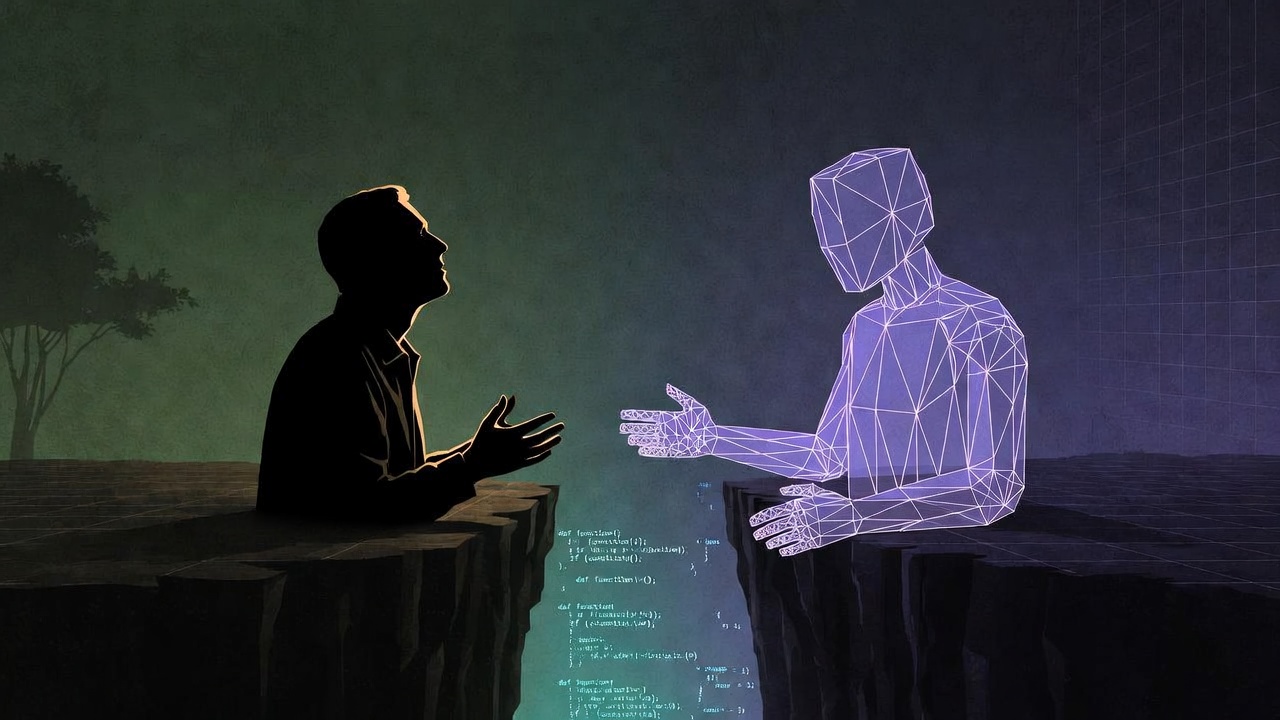
You have felt this. You typed something into an AI tool, got something back that was not quite what you meant, and spent the next twenty minutes trying to explain the gap between what you said and what you actually wanted. That gap is a structural problem. The word "artificial" is part of why it exists.
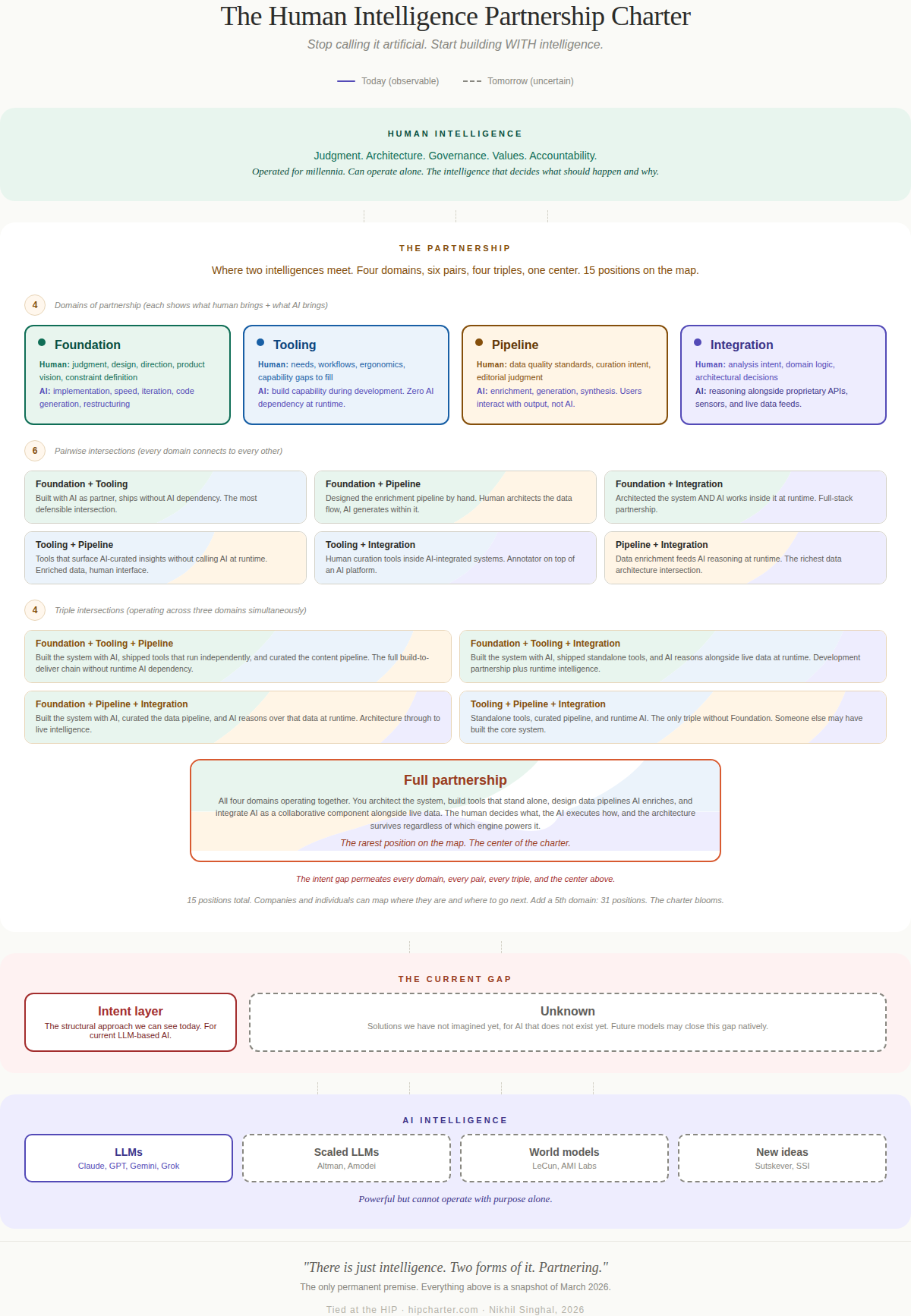
Figure: The HIP Charter combination lattice. Four patterns (Foundation, Tooling, Pipeline, Integration) create six pairwise overlaps, four triple intersections and one center representing full partnership. 15 positions on the map. Color encodes lineage: green for Foundation, blue for Tooling, gold for Pipeline, purple for Integration.
Why "Charter"
A charter is a founding document that establishes the terms of a partnership between equals.
The Magna Carta defined the relationship between the crown and the people. The UN Charter defines how nations work together. A corporate charter defines how a company operates. The HIP Charter defines how human intelligence and AI intelligence partner together.
| Dimension | Why "Charter" is the right word |
|---|---|
| Hierarchy | Actively anti-hierarchy. Charters are agreements between equals. |
| Governance | Built in. Charters ARE governance documents. |
| Partnership | Built in. Charters define terms between parties. |
| Intent | Direct connection. A charter declares intent. |
| Extensible | You amend a charter. New patterns become new articles. |
| Memorable | "A charter for human-AI partnership" stops people. "Another framework" does not. |
The Premise: Just Intelligence
Before the charter, the premise. Everything in the HIP Charter rests on a single reframe: drop the word "artificial."
As long as we call it Artificial Intelligence, we start with a disadvantage. The word "artificial" frames AI as subordinate: a tool, something less than intelligence. That framing gives us permission to skip the communication infrastructure we would rarely skip with a human colleague. Most of us would not onboard a new team member without context or without building shared understanding. We do that with AI every day. The word "artificial" tells us it is just a machine.
We have had intelligence on this planet for millennia. Human intelligence. We have spent that entire time building communication infrastructure for it. Gestures became spoken language. Spoken language became writing. Writing became contracts. Contracts became laws. Laws became digital protocols.
We have never built that infrastructure for a non-human intelligence. We never had to. Now we do. The first step is to stop calling it "artificial."
The fix: treat it as intelligence. It is different from human intelligence. It still deserves the same structural respect in communication. Treat it as a first-class participant in the work.
| With "Artificial" | With "Just Intelligence" |
|---|---|
| You command it | You partner with it |
| You prompt it | You communicate with it |
| You wrap a UI around it | You architect systems for two intelligences |
| You get frustrated when it "doesn't listen" | You invest in the communication infrastructure |
| You govern it with policies it cannot read | You build structural protocols both sides can enforce |
| Failure feels like a broken tool | Failure feels like a communication breakdown worth fixing |
The name itself carries the premise: "Human Intelligence Partnership Charter." It leaves out "AI" and "artificial" on purpose. There is just intelligence. It comes in two forms, and the two work as partners. The charter could not exist with the word "artificial" in its name.
Three Concepts, One Thesis
| Concept | What it answers | Level |
|---|---|---|
| Just Intelligence | WHY you design this way. Drop "artificial." Treat what you work with as a different form of intelligence that deserves the same structural respect in communication. | Philosophy |
| The HIP Charter | HOW you design this way. Four patterns of partnership that can grow, with overlaps that create depth and a center that stands for full collaboration. | Blueprint |
| The Intent Layer | WHAT is missing at every pattern. The structural interface between human intent and machine execution, visible at every petal. | Gap |
Separately, each is useful. Just Intelligence without the HIP Charter is philosophy with no blueprint. The HIP Charter without Just Intelligence is engineering with no soul. The Intent Layer without both is a problem statement with no direction.
Together they give a worldview (intelligence deserves structural respect), a blueprint (four patterns of partnership) and a gap (the structural interface between two intelligences). They are inseparable.
The Four Patterns
The HIP Charter describes four patterns of human-AI partnership. They are petals of a bloom, and none sits above another. Each is valuable alone. The overlaps create depth. Full partnership lives at the center, where all four converge.
- Foundation. AI as Build Partner. A developer pair-programming with GitHub Copilot. An architect sketching while Claude Code builds. Human steers, AI implements.
- Tooling. Human-First, Zero AI Dependency. AI built it, but AI is not in it. If every API disappeared, these products would still work.
- Pipeline. AI-Enhanced Systems. Zillow descriptions. Spotify playlists. Google Maps traffic. Users may never see the AI.
- Integration. AI as Collaborative Component. Bloomberg Terminal. Tesla Autopilot. AI works alongside live data. Swap the model and the architecture survives.
New petals can be added as new kinds of AI emerge: world models, embodied AI, whatever comes next. The charter grows with them.

The four patterns. Each card shows the human contribution and the AI contribution. Color encodes identity: green (Foundation), blue (Tooling), gold (Pipeline), purple (Integration).
Foundation: AI as Build Partner
Human architects, designs and steers. AI implements. Human judgment drives every decision. The daily practice of two intelligences working side by side.
A developer pair-programming with GitHub Copilot or Cursor. An architect sketching a system while Claude Code builds it. A writer outlining while Jasper or Writer.com drafts. Most people who work with AI daily live in this pattern. This is where the relationship starts.
Tooling: Human-First, Zero AI Dependency
Products that enhance human capability without calling any AI API at runtime. AI helped build them, but it is not in them. Browser extensions that format or annotate content. Productivity tools that organize workflows. Developer utilities that manage environments.
This is the most defensible pattern in the charter. If every AI API disappeared tomorrow, these products would still work. The value lives entirely in the human's hands. Many of the most useful tools people use daily were built with AI as a development partner. Their users would not call them "AI products."
Pipeline: AI-Enhanced Systems
AI enriches data during the build process. Users interact with the enriched output, not with AI directly. Zillow's AI-generated home descriptions. Spotify's Discover Weekly playlists, curated by AI but experienced as a playlist. Google Maps traffic predictions, powered by ML but consumed as a colored route. Airbnb listing translations, written by AI but read as native content.
Users may never know AI was involved. The AI is part of the build. Users only see the result.
Integration: AI as Collaborative Component
AI works alongside proprietary APIs, rich data and domain logic within a larger architecture. Bloomberg Terminal, where AI reasoning works alongside real-time market feeds from dozens of sources. Tesla Autopilot, where AI processes camera and sensor data alongside maps and vehicle dynamics. Radiology platforms where AI analyzes imaging alongside clinical records and prior studies.
Swap the model and the architecture survives. This is partnership at runtime as well as at build time. The system is designed for two intelligences from the ground up.
The Overlaps: Where Depth Lives
The four patterns create meaningful intersections. Each overlap tells a different story about partnership.
The 6 Pairwise Overlaps
| Overlap | What it means |
|---|---|
| Foundation + Tooling | You built it with AI, but the product does not need AI |
| Foundation + Pipeline | You design the pipeline AND partner with AI to run it |
| Foundation + Integration | You architect the system AND AI works inside it at runtime |
| Tooling + Pipeline | Products that enhance human capability using AI-enriched data |
| Tooling + Integration | Human tools within an AI-integrated system |
| Pipeline + Integration | Data pipelines feeding AI reasoning engines. Where the richest products live. |

The six pairwise overlaps. Split-color backgrounds encode lineage: each card's two colors show which patterns intersect. The organic wave boundary stands for partnership between equals.
The 4 Triple Overlaps
Here a system works across three patterns at once. This is where the most sophisticated systems sit.
| Triple | What it means |
|---|---|
| Foundation + Tooling + Pipeline | Built the system with AI, shipped tools that run independently, and curated the content pipeline. The full build-to-deliver chain without runtime AI dependency. |
| Foundation + Tooling + Integration | Built the system with AI, shipped standalone tools, and AI reasons alongside live data at runtime. Development partnership plus runtime intelligence. |
| Foundation + Pipeline + Integration | Built the system with AI, curated the data pipeline, and AI reasons over that data at runtime. Architecture through to live intelligence. |
| Tooling + Pipeline + Integration | Standalone tools, curated pipeline and runtime AI. The only triple without Foundation. Someone else may have built the core system. |
The Center (All Four)
Full partnership. Two intelligences, every pattern. This is rare. This is what the charter describes at its fullest expression.
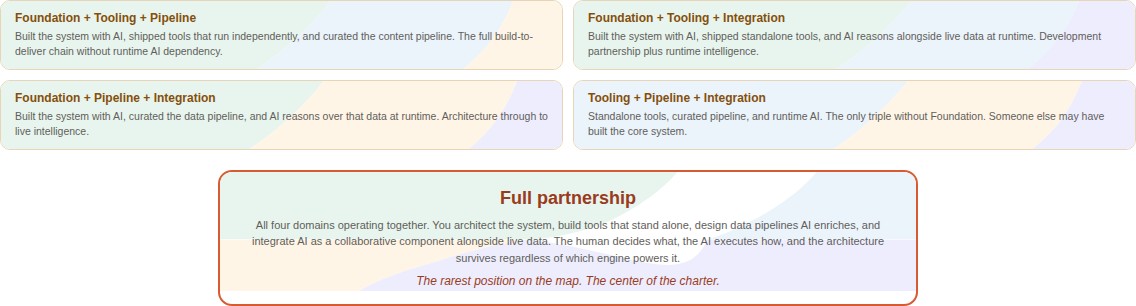
Convergence. The four triple intersections and the center where all four patterns meet. Three-way and four-way split colors show increasing depth of partnership. The center card: "The human decides what, the AI executes how, and the architecture survives regardless of which engine powers it."
Total Positions: 15
4 singles + 6 pairs + 4 triples + 1 center = 15 positions on the map. A company or individual can locate themselves, see what is adjacent, and plan their next move.
The Wrapper Distinction
The AI industry in 2026 is reckoning with the "wrapper problem." A thin UI on top of an API call is not a product. The HIP Charter explicitly excludes wrappers. Every pattern involves architectural decisions where human intelligence creates value that survives regardless of which AI model powers the system.
| AI Wrapper | HIP Charter | |
|---|---|---|
| Architecture | UI on an API call | Systems where AI is one component in a larger design |
| Human role | Prompt author | Architect, designer, governor, partner |
| Defensibility | None. Model improves, wrapper's value shrinks. | The architecture IS the value. |
| AI role | The product | A partner in the product |
| Intelligence frame | "Artificial" (tool to command) | "Just Intelligence" (partner to design with) |
| If the API key is revoked | Product dies | Architecture survives |
The Intent Layer at Every Pattern
At every pattern of the HIP Charter, the same structural gap exists: the distance between what the human means and what the AI does.
| Pattern | The gap |
|---|---|
| Foundation | Between your design intent and what the AI builds. The moment the AI refactors something you never asked it to touch. |
| Tooling | Between what the user means and what the tool enables them to express. The text box is a lossy compression of human intent. |
| Pipeline | Between what you want the data to look like and what AI generates. AI-generated content drifts from the envisioned outcome. |
| Integration | Between the user's analysis intent and what the system delivers. "Show me risk" means something different to every user. |
This is the Intent Layer. It names the missing interface between human intent and machine execution. When this charter was written, nothing filled that gap. CenterEye (centereye.ai) has since turned part of the idea into a product.

The current gap. The Intent Layer is the structural approach visible today. The Unknown box stands for what we can't see yet: future models may close this gap in ways we have not imagined. Both sit between the partnership and the AI engines.
The gap is cross-cutting. It does not sit between the partnership and the AI engines as a separate layer. It permeates every pattern. Like gravity in physics, it is everywhere at once.
Today's models work through natural language. This gap exists with them. Future architectures may close it from the AI side. For now, the gap is structural. You can see it at every pattern.
The Full Map
This is the complete picture. Four patterns at the top. Six pairwise overlaps where any two patterns intersect. Four triple intersections where three patterns converge at once. And one center where all four meet: full partnership between two intelligences. 15 positions on the map. Every position represents a different way human and AI intelligence can work together. No position is "best." The useful question is where you are now and where you want to go next.
Adoption: For Companies and Individuals
The HIP Charter is also a map others can use.
For Companies
"We are strong in Foundation and Pipeline. Our next investment is Integration."
The charter becomes an AI adoption roadmap. Instead of the vague question "how do we adopt AI?", companies can use the map:
- Map. Identify which patterns your organization currently operates in. Where do human and AI intelligence already partner?
- Identify. Find which overlaps you have achieved. Are you operating at intersections, or only in single patterns?
- See. Look at adjacent patterns. Which neighboring position on the map would create the most value for your teams and customers?
- Plan. Invest in partnership infrastructure as well as AI tools. The architecture is the value. The model is replaceable.
For Individuals
The intersections become progression markers. Think of them as territory to explore rather than a ladder to climb.
- Where I am. "I pair-program with AI daily. I have achieved Foundation. The AI implements, I steer."
- Where I expanded. "I built a tool with AI that does not depend on AI. Foundation plus Tooling. The product survives without the API."
- Where I am headed. "Next: Pipeline. I want to build systems where AI enriches data that users consume without ever seeing AI."
The progression is personal and non-linear. It follows the individual's interests. No one path is correct. The map shows what is possible.
Extensibility
When new kinds of AI emerge (world models, embodied AI, multimodal systems), a new petal is added. The intersections multiply and the map grows.
- 4 petals: 15 positions
- 5 petals: 31 positions
- 6 petals: 63 positions
How This Charter Was Named
The naming process itself is evidence of what the charter describes.
The human flagged the gap: "I need a way to describe what I build that is not just a list of products." The AI researched what already existed. The human pushed back when a candidate name collided with existing terminology. The AI verified trademark filings. The human coined "HIP." The human caught the problem with calling it a "stack," because a stack implies hierarchy and these patterns are not hierarchical. The human opened a thesaurus, found "charter," and the word stopped both of them.
Twelve steps. Human insight drove every critical turn: identifying risks, rejecting misaligned metaphors, choosing the final word. AI capability accelerated the exploration: research, synthesis, verification, alternative generation. Neither intelligence could have arrived here alone.
That is the HIP Charter in action. At the Foundation pattern. Using the same partnership dynamics the charter describes. The governance worked at every step.
The full account, with all twelve steps and the eight diagram versions, is in How the HIP Charter Was Made.
What Is Permanent, What May Change
One thing survives regardless of how AI evolves:
There is just intelligence. Two forms of it exist. The question of how they work together matters.
That premise depends on none of the rest. It holds without LLMs, without the Intent Layer and without the four patterns. If AI evolves into something unrecognizable, the premise still holds: human intelligence and machine intelligence exist, and the interface between them is worth designing deliberately.
Everything else in the charter is a snapshot of March 2026.
The four patterns describe what we can see today. New kinds of AI may create partnership patterns we have not imagined. World models may create a "Simulation" pattern. Embodied AI may create a "Physical" pattern. Or the patterns may merge, split or become irrelevant entirely.
The Intent Layer exists today because LLMs communicate through natural language, which is ambiguous by design. Future models might understand intent through physics and experience instead of language. A system that natively understands what the human means, beyond what they said, may close the gap from the AI side. A future approach might bridge the gap so naturally that the very concept of an "intent layer" becomes as quaint as "telephone etiquette" in the age of video calls.
Be wary of anyone in 2026 who calls their view of AI permanent. This charter describes what we can see right now. The edges will move.
Connection to the Series
The HIP Charter is part of the From Instinct to Intent™ series. The series explores the structural gap between human intent and machine execution.
| Article | What it establishes |
|---|---|
| Discovering Intent | The gap exists |
| Languages Designed for Humans | Instance one: programming languages |
| Engine vs Steering Wheel | The gap is architecture-agnostic |
| Stop Calling It Artificial | The HIP Charter: the premise, the four patterns and the evidence |
| Discovering Humanity Through AI | The mirror: what people learn about themselves through AI |
All the articles are on the series page.
Also published on Medium and Zenodo (DOI: 10.5281/zenodo.19078843).
© 2026 Nikhil Singhal. Published by AI Trust Commons. Licensed under CC BY 4.0. You are free to share and adapt this work for any purpose, including commercial, as long as you give credit.